



Tavola Rotonda Viola
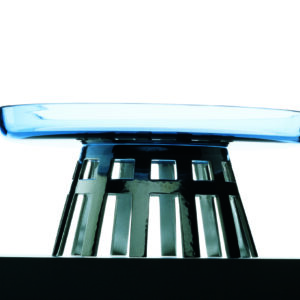
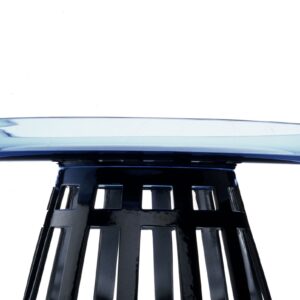
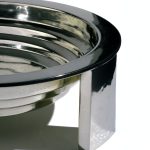
Pedestal stand in pewter and Murano glass ø cm 32 x 14,5 h, limited edition of 99 pieces. Pewter casting hand-finished with soldering and brush polishing operations. Blown Murano glass plate.
| Weight | 5,5 kg |
|---|---|
| Dimensions | 32 × 32 × 14,5 cm |
| Collezione | Tavole |
| Design | Ettore Sottsass |
| Edizione Limitata | 99 pieces |
| Materiale | Cast pewter hand-finished with welding and brush-polishing operations. Blown Murano glass plate. |
The edition size is the planned total for the edition, not the number of pieces currently available.
This work is part of the NUMA catalogue. Contact us to enquire about availability or other works in the collection.
The complete story of the work
Translated from the Italian original.
Tavole are six large limited-edition centrepieces, in pewter or pewter and blown glass “designed to give meaning to the table and make it more magical and ritual”. Extraordinary interpretations by Ettore Sottsass of traditional materials, in the strongly iconic language that distinguishes the great master.
Ettore Sottsass’s design journey leads us, in 2004, to the meeting of the lightness and colour of Murano glass with the strong architectural construction of the pewter parts. The transparency of the glass does not hide the structure of the metal; it discreetly contains and protects the good fruits and offers them to our desire as a precious possession. The fourth collection of NUMA consists of six pieces, six centrepieces that tell us of the joy and pleasure of conceiving objects that will accompany us in our daily gestures and rituals, becoming a happy part of our everyday life.
«Pewter is an ancient metal alloy: tin, copper, lead… what is produced with this alloy is motionless, solid, heavy. Contemporary pewter no longer contains the lead that gave objects a dark, medieval, Germanic surface: this alloy contains antimony instead: thus brilliant, silver-like objects are made, which nevertheless do not lose their immobility and presence».
Ettore Sottsass
Pewter is an ancient material, which was already worked in Europe in the early sixteenth century, by casting a tin alloy in engraved iron or brass moulds and then working it with the techniques of etching and hammering to obtain forms from the craft tradition. Contemporary pewter, the protagonist of the Numa collections, is a noble alloy in every respect, with extraordinary ductility and great plasticity. Contemporary Pewter is made of a composite blend of metals, with the absolute exclusion of lead; it therefore keeps unaltered the distinctive characteristics that set it apart and its great plasticity; it is absolutely hygienic and can be used to make objects for serving at table and in the kitchen, as well as, of course, for all furnishing objects.
Material:
Pewter is an alloy composed of tin and small quantities of antimony and copper. Thanks to its ductility, it has been used by man since antiquity to create objects of everyday use. In more recent centuries, a percentage of lead was added to the tin, which was soon banned because of its toxicity. The pewter used to make Numa objects is an alloy composed of 95% tin, and the complete absence of lead makes it fully compliant with the EEC standard EN-611/1.
Production stages:
- The first operation in the production cycle is the purchase of the raw material, either in ingots or sheets of pewter ready to be melted, or in ingots or sheets of tin, copper wire or rods and antimony, which, melted in the dedicated melting furnace at a temperature of 250-300° C, give pewter
- The molten metal is poured by hand with a ladle into rubber moulds. These moulds are mounted on centrifuges: machines that spin the mould during the pouring and drying phase of the alloy.
- After the drying phase the operator removes the product, which is then deburred with scissors and ground.
- For the pieces that need it, manual assembly by tin soldering follows
- The pieces are then placed by hand into the vibrators, where they remain for about 2 hours. Vibration smooths the surface of the object by means of water and ceramic inserts (inert material).
- On leaving the vibrators the pieces are checked and, if necessary, straightened with rubber hammers. After this stage comes the final stage of hand polishing with brushes.
- Finally, each individual piece is stamped with the designer’s signature, the Numa logo and its numbering.
N.B. All production stages are carried out by highly specialised craftsmen, at the atelier of the Master pewterer Alfredo Marinoni, Cellatica (BS).
Specifications
| Weight | 5,5 kg |
|---|---|
| Dimensions | 32 × 32 × 14,5 cm |
| Collezione | Tavole |
| Design | Ettore Sottsass |
| Edizione Limitata | 99 pieces |
| Materiale | Cast pewter hand-finished with welding and brush-polishing operations. Blown Murano glass plate. |
Request information about this work
Write to us to ask about the availability of a piece, lead times or other works in the collection. We will reply to the address you provide.
Your enquiry concerns: Tavola Rotonda Viola (ME9TAV/VIOL)