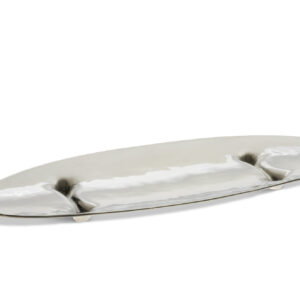
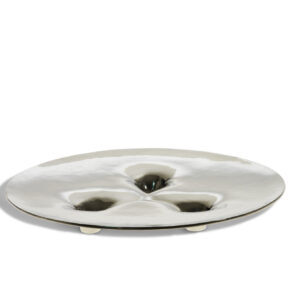
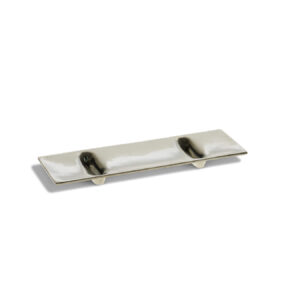
Metallia


Metallia
«Pewter is an ancient metal alloy: tin, copper, lead... what is produced with this alloy turns out immobile, solid, heavy. Contemporary pewter no longer contains the lead that gave objects a dark, medieval, Germanic surface: this alloy contains antimony instead: objects are thus made that are brilliant, similar to silver, yet do not lose their immobility and presence». Ettore Sottsass
The Metallia collection is the first project realised by NUMA in 1999.
Serafino Zani’s Metallia project offers pewter anew through the interpretation of different designers and the craft knowledge of the pewter master Alfredo Marinoni. An occasion for encounter between the knowledge of the craftsman, who knows the material and the techniques for working it, the poetics underlying the project and the modern language that gives matter a new expressiveness and feeling, within a broader path of research and production by Serafino Zani.
The intention was to offer a material such as pewter, capable of great plastic effects, in a new and original way, through the interpretation of designers of particular sensibility, and the craft knowledge of Alfredo Marinoni, the pewter master who made the designs. The design framework was overseen by Marco Susani and Mario Trimarchi, who called on the collaboration of Tamar Ben David, Liliana Bonomi, Giovanni Levanti.
The support of Ettore Sottsass, anarchic poet of the architecture of this century and one of the fathers of design, was of fundamental comfort to the project.
Metallia therefore represents, in the path undertaken by NUMA, the first occasion of encounter between the knowledge of the craftsman, who knows the material and the techniques for working it, and the poetics of the project, which gives matter a new expressiveness, the feeling of a new ethical and symbolic dimension of making.
Metallia is contemporary pewter. To rediscover an ‘ancient’ material such as pewter, and give it new forms, characterise it with new surfaces, fill it with new meanings: this is the Metallia project, whose aim is to offer pewter objects once more through the interpretation of different designers, of their modern language, with the fundamental contribution of the know-how of Alfredo Marinoni. Metallia represents the meeting between the craftsman, who knows the material and how to work it, and the poetics of the project, which gives the material a new expressiveness.
Pewter is an ancient material, which was worked in Europe as early as the beginning of the sixteenth century, by pouring a tin alloy into engraved iron or brass moulds, and then working it with the technique of etching and hammering to obtain forms of the craft tradition.
Contemporary pewter, protagonist of the Metallia collection, is a noble alloy in every respect, with extraordinary ductility and great plastic quality. Contemporary Pewter is made up of a composite of metals, with the absolute exclusion of lead; it therefore retains unaltered the distinctive characteristics that set it apart and its great plastic quality; it is absolutely hygienic and can be used to make objects for serving at table and in the kitchen, as well as, naturally, all furnishing objects.
The insight at the heart of METALLIA gives new strength to this ancient material, and the forms, the objects, the proposals created are the truly remarkable result of the great artistic abilities of the designers that pervade the work of Numa. This is also borne out by the fact that Tamar Ben David, Liliana Bonomi, Giovanni Levanti, Ettore Sottsass, Marco Susani and Mario Trimarchi, designers of marked artistic sensibility, particularly attentive to the use of materials in both the craft and industrial fields, have joined with enthusiasm in the realisation of the METALLIA project. The result of this work is expressed in a programme of 28 objects, to decorate the table and the home, objects of great evocative power, which find a natural place in any setting. The Metallia project is also the precise expression of the philosophy of the Numa brand, aimed at deepening research into and production of objects using materials traditionally used by craftsmen, but reinterpreted in the light of design.